

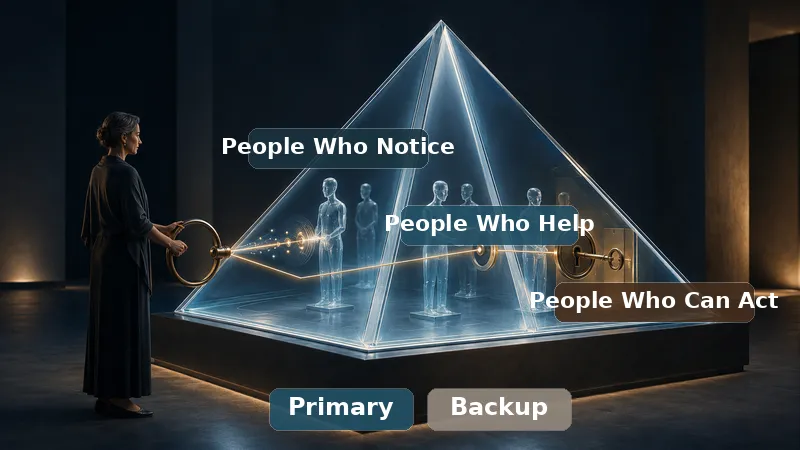
How Do You Build a Support Team If You Do Not Have Children?
An emergency-contact form asks for one name. A medical form asks for another, and an account form asks for a trusted contact. The same friend may come to mind each time, even though each form creates a different job.
People without children often build strong support networks from personal and professional relationships. Friends, extended family, and neighbors may each play a part. A usable team begins with the work. Start by defining each responsibility and asking who is willing. Then identify the permission each role requires and the backup if the first choice is unavailable.
What work does the team need to cover?
Begin with situations you can picture. Who could bring you home after an outpatient procedure? Who could check the house during a hospital stay? A nearby person might help with transportation, a pet, or a home-service call. Research on support networks separates practical tasks from companionship and health advocacy. Caregiving and financial administration create other responsibilities. [1]
The person who gladly handles an occasional errand may decline an ongoing coordination role. Another friend may be comfortable discussing your wishes while preferring to stay away from financial responsibility. A Mather Institute study treats conversations about future wishes and document access as distinct preparations. It also separates financial planning, healthcare advocacy, and caregiving arrangements. [2] Defining the job gives each person a request they can evaluate honestly.
What makes each role usable?
A person’s willingness is one part of the plan. The role may also require information or consent. Some roles depend on a signed document or account designation. The same review should identify how the work continues if the first person cannot serve.
Work | What makes it usable | If the first choice is unavailable |
|---|---|---|
Practical help, such as a ride or house check | A clear request, agreement, and current contact details | Another person or a paid local service |
Information and coordination | Your consent and the access needed for that task | An alternate coordinator or established professional |
Medical or financial decisions | The applicable legal document or account authority | A successor named through the same process |
When does support become legal authority?
A brokerage trusted contact shows the boundary clearly. The brokerage firm may contact that person in limited circumstances, including difficulty reaching you or possible financial exploitation. The designation gives the contact no power to trade, withdraw money, or make account decisions. [3]
Healthcare and financial decisions follow different paths. A healthcare proxy may make covered medical decisions when the conditions in the document and state law are met. [4] A financial power of attorney gives an agent the authority stated in the document, with state law shaping how that authority works. [5]
Name each role through the process that creates it. A successor healthcare agent belongs in the healthcare document. A successor financial agent belongs in the financial power of attorney. An emergency contact cannot inherit either role simply because the first person is unavailable.
Dovetail Principle: A Plan Is Built on Decisions You Can Stand Behind
The people you choose may affect your privacy and care. Some roles can also affect your money or independence. Separating each responsibility lets you choose a friend for practical help, another person for formal authority, and a professional when continuity or specialized experience matters.
Where can professional support fit?
Some jobs call for more time or specialized knowledge than a friend wants to provide. An Aging Life Care Professional may assess needs and coordinate care. The professional may also identify local resources or help during a hospitalization. [6] An estate-planning attorney or daily money manager may also belong in the plan. Other roles may call for a trust officer or professional fiduciary.
A professional arrangement needs the same role definition as a personal one. Ask about fees, scope, and credentials. Also ask about conflicts, availability, and the process for beginning service. Legal guidance for adults aging without traditional family support emphasizes successor appointments and careful review of professional fiduciaries. [7]
The expected cost belongs in the financial plan, along with the documents and account arrangements that support the role. Dovetail’s Legacy & Family Support planning connects these choices with the resources, relationships, and responsibilities they may affect.
How do you keep the team current?
For every essential responsibility, record the work and the primary person. Add the backup and the source of permission or authority. Keep current contact information with the signed documents, and account details the right people may need.
Have one conversation at a time. Explain the job and likely time commitment. Describe the information access and limits. Confirm that the person agrees. Revisit the arrangement after a move or diagnosis. Review it again if a relationship or someone’s availability changes.
The result is a team built around real responsibilities. Each person knows the job they accepted, and each essential role has another path if circumstances change. For a shared-household version, see How Should Couples Without Children Build a Support Team for Later Life?
Related Reading: How Is Retirement Planning Different When You Are Single or Have No Children?
